

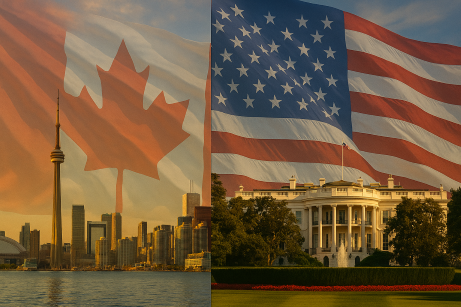
Prime Minister Mark Carney’s upcoming visit to Washington, his second since taking office, may mark a critical moment in Canada’s trade talks with the United States. Carney recently dropped many of Canada’s counter-tariffs on U.S. goods covered under the Canada-U.S.-Mexico Agreement (CUSMA), a move he confirmed was encouraged by President Donald Trump to help accelerate negotiations. Trump, who once openly mused about Canada joining the U.S. as a 51st state, now appears to be approaching bilateral trade more seriously than during Justin Trudeau’s tenure, signaling a possible opening for a breakthrough deal.
Key Facts
- Canadian GDP contracted 1.6% in Q2 (annualized); grew just 0.4% in the first half.
- Exports fell 7.5%, the largest drop in five years
- U.S. tariffs target five sectors: steel, aluminum, autos, lumber, and copper
The economic backdrop is growing more fragile. Canada’s economy shrank in the second quarter by a wider margin than expected, primarily due to a 7.5 percent drop in exports. That decline, driven by U.S. tariffs across key industrial sectors, marks the sharpest pullback in trade since 2020. Domestic demand remained solid, with household spending and government expenditures rising, but the weak external performance dragged overall GDP growth to just 0.4 percent for the first half of the year. The Bank of Canada has held rates steady at 2.75 percent, though markets are now pricing in higher odds of a cut in September if the trend continues.
While talks with the U.S. have been ongoing for months, Carney’s team has prioritized securing the “best deal” over reaching a fast resolution. Trade Minister Dominic LeBlanc told senators that discussions remain active and that a separate agreement on tariffs, outside of the CUSMA review, remains a realistic goal. Still, he cautioned that relations between the two countries may not return to the levels seen a generation ago.
At home, Carney faces growing criticism for failing to meet his self-imposed July 21 deadline to reach an agreement. Conservative Leader Pierre Poilievre has used the missed timeline to question Carney’s leadership, saying the promised “win” with Washington has yet to materialize.
Investors should be watching closely. A credible path to resolving the tariff standoff could support a rebound in export-driven sectors and ease pressure on GDP in the coming quarters. Without a deal, the risk of a broader economic slowdown will continue to rise. But despite the concerns, the TSX has been doing well this year and is up around 23%, which is better than the S&P 500‘s gains of less than 15%.