


On October 28, 2026, the Bank of Canada raised its policy interest rate by 25 basis points to 2.5%. The decision puts renewed attention on how dividend-paying businesses respond when borrowing costs rise and inflation remains persistent.
A single quarter-point increase does not establish a new aggressive tightening cycle. Monetary policy depends on incoming economic data. In its October announcement, the Bank highlighted persistent energy-price pressures and the risk that higher production and transportation costs could spread more broadly through the economy.
For dividend investors, the distinction matters: businesses that can withstand higher financing costs or benefit from stronger commodity prices may behave differently from companies usually described as defensive.
Why Traditional Dividend Defensives Can Struggle
Utilities, telecoms, and real estate investment trusts can face pressure when interest rates rise quickly. Although their revenues may be relatively stable, many depend on substantial capital investment and debt financing.
Higher borrowing costs can reduce cash available for investment and distributions as debt is refinanced. Rising bond yields can also make equity dividend yields less attractive by comparison. The impact varies with debt maturities, fixed-rate borrowing, regulation, and each company’s ability to raise prices.
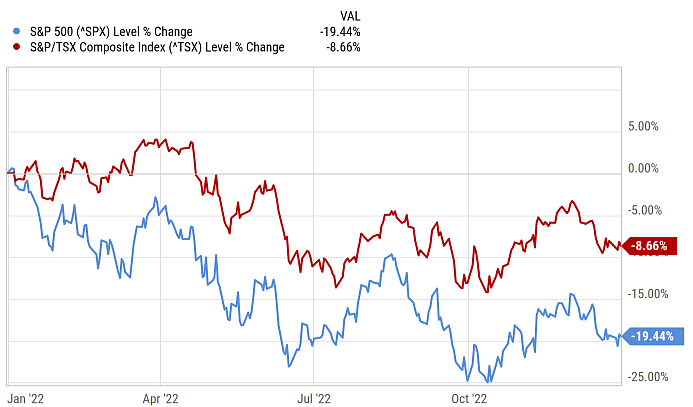
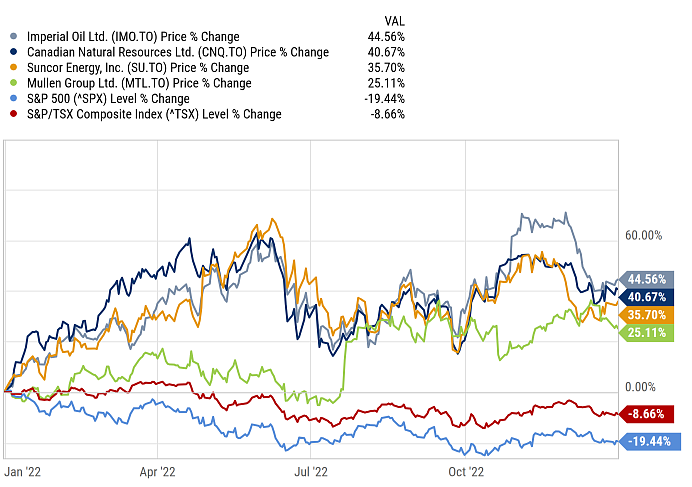
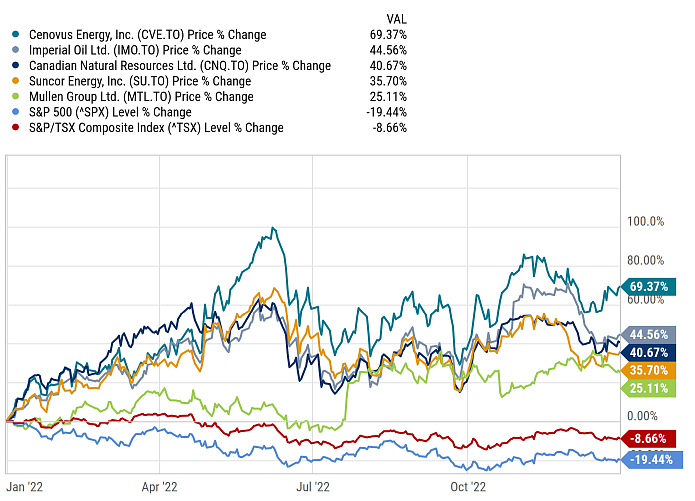
The 2022 tightening cycle offers a useful historical comparison. The five companies considered here recorded strong share-price gains: Mullen Group, Suncor Energy, Canadian Natural Resources, Imperial Oil, and Cenovus Energy. Their business models help explain why energy exposure, cost recovery, and balance-sheet flexibility can matter more than a defensive-sector label. Higher rates themselves were not necessarily the cause of those gains.
The companies below appear in ascending order of their approximate 2022 share-price gains. These figures are historical context rather than forecasts or a standardized comparison of total returns, which would also account for dividends.
1. Mullen Group (MTL): Logistics and Cost Recovery
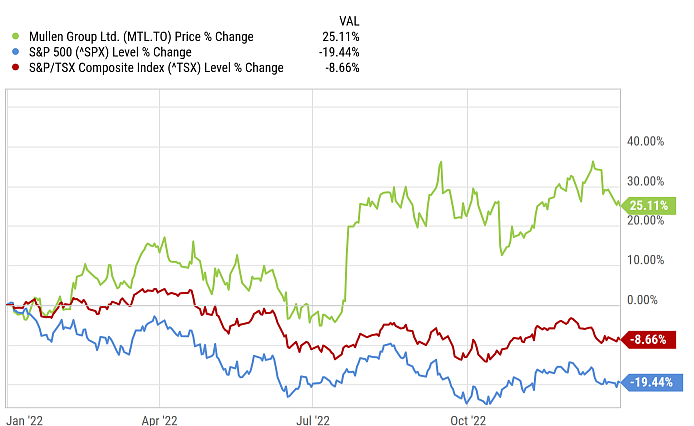
Mullen Group’s share price rose more than 25% in 2022. Its logistics operations offer a different kind of exposure from the energy producers that dominate this comparison.
Mullen Group is one of Canada’s largest logistics and supply chain companies, operating a decentralized network of more than forty standalone business units across four segments: Less-Than-Truckload regional shipping, Logistics and Warehousing, Specialized and Industrial Services, and U.S. and International 3PL and customs brokerage.
Three features underpin the investment case: the ability to recover rising transport costs, exposure to industrial activity, and control over key operating assets.
Fuel surcharges and freight-rate adjustments can help Mullen recover increases in diesel and other operating costs. These mechanisms may protect margins, although competitive conditions and weaker shipping demand can limit pricing power.
Mullen’s Specialized and Industrial Services operations support energy and mining activity in Western Canada through services such as pipeline hauling, water management, and drilling support. Strong commodity markets can encourage customers to invest and increase demand for these services, but that relationship can reverse when activity slows.
Ownership of terminal real estate and fixed-rate borrowing can also reduce exposure to abrupt increases in lease and financing costs. Those advantages provide flexibility rather than complete insulation: property maintenance, labour costs, and eventual debt refinancing remain relevant.
2. Suncor Energy (SU): An Integrated Energy Business
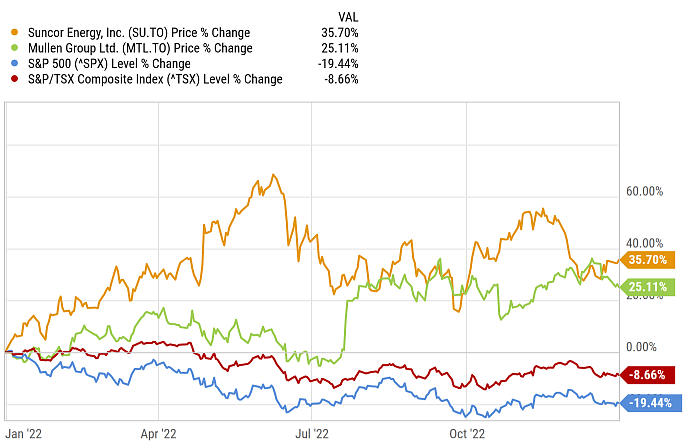
Suncor’s share price gained approximately 36% in 2022. Its appeal in an energy-led inflationary environment lies in the combination of production, upgrading, refining, and fuel marketing.
Suncor’s upstream operations include major oil sands mining and upgrading assets around Fort McMurray, including Base Plant, Syncrude, and Fort Hills. Its downstream business includes refineries and the Petro-Canada retail and wholesale network.
Integration gives Suncor exposure to margins at several stages of the energy supply chain, although it does not guarantee that every stage benefits simultaneously. Its 2022 annual report recorded strong cash generation, dividend increases, share repurchases, and net debt reduction. Operational reliability, capital discipline, and commodity prices remain central to whether that cash generation can be sustained.
3. Canadian Natural Resources (CNQ): Long-Life Production Assets
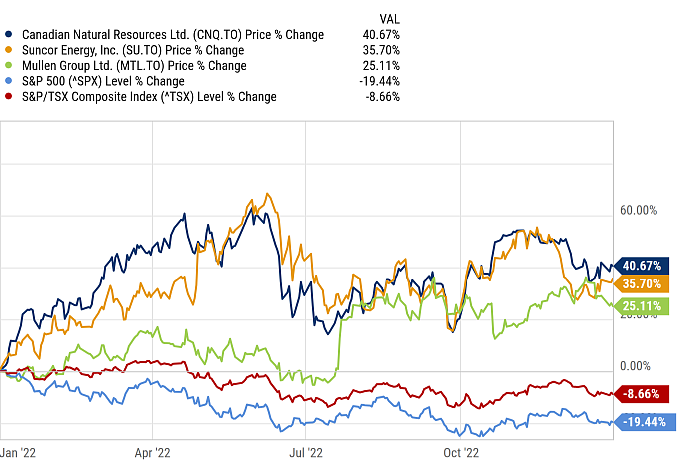
Canadian Natural Resources’ share price rose roughly 41% in 2022. Unlike an integrated retail refiner, its business is primarily focused on producing oil and natural gas.
Its diversified production base includes oil sands mining and upgrading at Horizon and the Athabasca Oil Sands Project, thermal in-situ oil, conventional crude, and natural gas operations. Long-life assets are an important part of its operating model.
Reserve life and the need for replacement investment help explain the attraction of these assets. Rapidly declining wells require ongoing drilling to maintain production, and inflation can increase the cost of that work. Established oil sands mines have a different production profile, although they still require significant maintenance, operating expenditure, and periodic capital investment.
Higher commodity prices can therefore support stronger cash generation without a matching increase in some categories of replacement spending. Canadian Natural’s 2022 annual report described record operating and financial results, substantial free cash flow, and significant shareholder returns. Taxes, royalties, cost inflation, and commodity-price declines nevertheless affect how much cash ultimately remains available for dividends and buybacks.
4. Imperial Oil (IMO): Financial Flexibility and Refining Exposure
Imperial Oil’s share price climbed nearly 45% in 2022. The company combines upstream production with refining and fuel marketing.
Majority-owned by ExxonMobil, Imperial produces oil from assets including the Kearl oil sands mine and Cold Lake thermal operations. Its downstream business refines crude and markets fuel through the Esso and Mobil brands.
The investment case centres on financial flexibility and exposure to more than one part of the energy value chain. A relatively modest debt burden can reduce sensitivity to higher financing costs, while refining can provide a different earnings stream from oil production. Neither feature eliminates exposure to weak demand, changing refining margins, or operating disruptions.
Imperial has a long history of dividend payments and has also used share repurchases to return capital. Buybacks reduce the number of outstanding shares and can increase per-share ownership of the business, but their benefit depends on the purchase price and subsequent operating performance.
5. Cenovus Energy (CVE): Heavy Oil and Downstream Integration
Cenovus recorded the largest gain among these five companies, with its share price rising just under 70% in 2022. Its operations combine oil and natural gas production with upgrading and refining.
Its upstream portfolio includes thermal in-situ oil sands projects such as Foster Creek and Christina Lake, alongside conventional natural gas and offshore operations. Its downstream assets include manufacturing facilities in Canada and the United States.
Heavy Canadian crude often trades at a discount to lighter oil benchmarks. Refineries configured to process heavy crude can capture value by turning that feedstock into marketable fuels and other products. Integration therefore offers a partial offset to changes in crude-price differentials, rather than a guarantee of strong margins throughout the business.
Cenovus illustrates how upstream and downstream earnings can interact during an energy-price shock. Stronger cash generation can support debt reduction, dividends, and buybacks, while weaker commodity prices, refining outages, and higher operating costs can work in the opposite direction.
The Broader Lesson: Business Models Matter More Than Labels
These five businesses generate cash from producing energy, refining fuel, or moving goods. Their potential resilience rests on specific operating features (commodity exposure, cost recovery, long-life assets, integration, and financial flexibility), not on a universal benefit from higher interest rates.
A repeat of 2022 is not assured. Four of the five companies are energy businesses, so this group represents substantial sector concentration rather than broad diversification. A slowdown in global demand or falling oil prices could outweigh any protection offered by tangible assets or lower debt.
The practical takeaway is to examine how each company earns cash, funds investment, and sustains its dividend across an economic cycle. Historical gains can illustrate a business model, but valuation, balance-sheet strength, capital requirements, and downside risks determine whether the same business remains attractive today. This article is general information, not personalized investment advice.